
Butte County Small Claims Court provides a legal process for resolving money disputes without the time and expense often associated with larger civil court cases. People use this court to seek payment for unpaid debts, property damage, broken agreements, security deposit disputes, consumer complaints, and other financial disagreements. Small claims cases in Butte County are commonly filed by residents, landlords, tenants, consumers, and small business owners who need a court decision on a limited-value claim. The court process is structured to help parties present evidence, explain their position, and receive a judgment from a judge. Many claims involve straightforward financial losses, making small claims court a practical option for recovering money or settling a dispute through the legal system.
Small claims cases in Butte County follow a process that includes claims filing, serving court papers, attending a hearing, and presenting supporting documents such as contracts, receipts, invoices, photographs, or payment records. The court reviews information from both sides before making a decision based on the facts presented during the hearing. People often choose this court for minor lawsuits because it offers a clear path for resolving disputes involving money, property, or services. Whether the issue involves an unpaid bill, vehicle damage, landlord-tenant disagreement, or contract-related claim, Butte County Small Claims Court serves as a local forum where parties can seek a legal resolution and pursue financial recovery through an established court process.
What Is Butte County Small Claims Court?
Butte County Small Claims Court is a special division of the superior court that handles civil disputes involving limited amounts of money. It provides a simplified dispute resolution process for people seeking justice without expensive legal fees. This court focuses on resolving minor lawsuits efficiently. Traditional lawsuits involve complex rules, lengthy discoveries, and high costs. Small claims court skips these burdens. A plaintiff presents their side, the defendant presents theirs, and a judge makes a quick ruling. The purpose centers on accessibility. People can represent themselves easily. The court uses plain language forms instead of complicated legal documents.
- Types of Cases Handled: The court hears various money disputes. Cases often involve broken oral or written agreements. People sue for unpaid loans, returned checks, or security deposit returns. Other cases involve consumer complaints or minor property damage.
Benefits of Small Claims Court
- Low Cost: Filing fees range from $30 to $75.
- Speed: Cases usually reach a hearing within a few months.
- Simplicity: Plaintiffs fill out basic forms without legal jargon.
- No Lawyers: Both sides speak directly to the judge, keeping the process fair.
Types of Small Claims Cases Filed in Butte County
Small claims cases in Butte County usually involve money disputes over unpaid debts, property damage, or broken contracts. People file these minor lawsuits to recover financial losses without paying high legal costs. The court sees a wide variety of complaints. Knowing the common types helps plaintiffs determine if their case fits the criteria.
Unpaid Debt Claims
Unpaid debt claims happen when someone borrows money and fails to repay it. Plaintiffs can sue for personal loans, unpaid rent, or bounced checks. The plaintiff must show proof of the loan and the missed payments.
Property Damage Claims
Property damage claims arise when someone ruins or destroys another person’s belongings. Examples include a neighbor breaking a fence or a driver damaging a parked car. The plaintiff seeks money to cover repair or replacement costs.
Security Deposit Disputes
Tenants often file security deposit disputes when a landlord refuses to return their money after moving out. California law requires landlords to return deposits or provide an itemized list of deductions within 21 days.
Contract Disputes
Contract disputes involve broken agreements between two parties. A person might sue a contractor who took payment but failed to finish a job. Even verbal agreements count, though written contracts provide better proof.
Consumer Complaints
Consumer complaints occur when a product or service fails to meet advertised standards. Buyers can sue sellers for selling defective cars, performing shoddy repairs, or refusing to honor warranties.
Who Can File a Small Claims Case in Butte County?
Any person or business with a valid legal claim against someone in Butte County can file a small claims case. The person starting the lawsuit acts as the plaintiff, and the person being sued is the defendant https://www.butte.courts.ca.gov/small-claims. Both people and formal entities can use this court. A person must be at least 18 years old to file. Minors need a parent or guardian to file on their behalf. Businesses can also file lawsuits. A corporation, partnership, or sole proprietorship can sue a customer for unpaid bills.
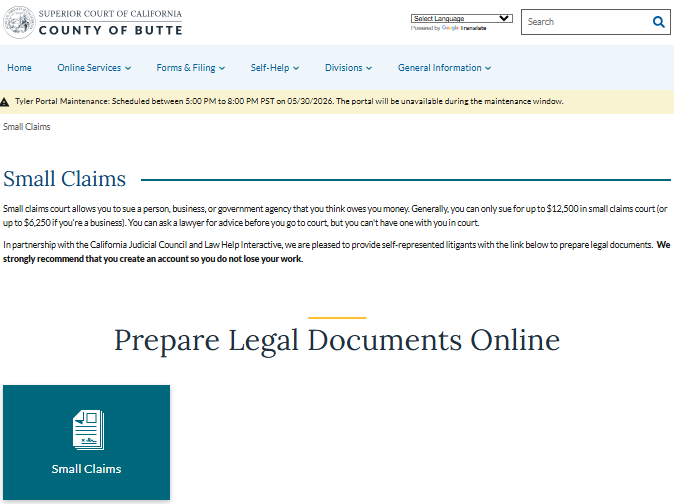
- Eligibility Rules: Plaintiffs must follow specific rules. The defendant must live, work, or do business in Butte County. If the incident happened in Butte County, the plaintiff can file there. The plaintiff must demand a specific dollar amount. They cannot ask the court to force the defendant to act, like fixing a car. The court only orders money payments.
Small Claims Court Limits in California
California sets strict claim amount limits for small claims court, capping how much money a person or business can sue for. In Butte County, these filing limits depend on the plaintiff’s status and the number of claims filed per year. Plaintiffs cannot ask for more than the legal maximum. If a claim exceeds the limit, the plaintiff must either drop the extra amount or file in civil court.
- Person Claim Limits: An unmarried person can sue for up to $12,500. A married person or a registered domestic partner can also sue for up to $12,500, as long as their spouse has not filed a separate claim exceeding this amount.
- Business Claim Limits: Corporations, partnerships, and unincorporated associations face a lower cap. A business can only sue for up to $6,250.
- Multiple Claims: A person can file as many claims as they want for $2,500 or less. For claims over $2,500, a person can only file two per calendar year.
| Filer Type | Maximum Claim Amount |
|---|---|
| Person | $12,500 |
| Business / Corporation | $6,250 |
| Claim over $2,500 (limit per year) | 2 claims |
How to File a Small Claims Case in Butte County
To file a small claims case in Butte County, a plaintiff must complete court forms, pay filing fees, and submit documents to the court clerk. The court then issues a hearing date for the case. Filing requires careful attention to detail. Missing a step can delay the case. The claims filing process involves four main steps.
Complete Court Forms
The plaintiff must fill out Form SC-100, the Plaintiff’s Claim and ORDER to Go to Small Claims Court. This form asks for the plaintiff’s information, the defendant’s details, and the reason for the lawsuit. The plaintiff must state the exact amount owed. Plaintiffs must fill out a separate form for each defendant.
Pay Filing Fees
Filing requires a fee. The cost depends on the claim amount and how many claims the plaintiff has filed in the past year.
- Claims up to $1,500: $30
- Claims from $1,500.01 to $5,000: $50
- Claims from $5,000.01 to $12,500: $75
Plaintiffs who have filed more than 12 claims in the past 12 months pay a higher fee of $100. Fee waivers exist for low-income filers.
Submit Documents
The plaintiff submits the completed forms to the Butte County Superior Court clerk. The clerk reviews the paperwork and stamps the copies. The clerk keeps the original and returns stamped copies to the plaintiff. Plaintiffs can submit documents in person or by mail.
Receive Court Date
After submitting the paperwork, the clerk assigns a court date. The hearing usually happens 20 to 70 days after filing. The plaintiff must write this date on the defendant’s copy of the form before serving it.
Serving the Defendant
Serving the defendant means delivering legal notice of the small claims court case to them in Butte County. This service process ensures the defendant knows about the lawsuit and the upcoming hearing date. The court cannot hear a case if the defendant fails to receive proper notice. The plaintiff cannot serve the papers themselves. California law requires someone else to deliver the documents.
Service Requirements: The server must be at least 18 years old and not involved in the case. The server hands the defendant a copy of the Plaintiff’s Claim (Form SC-100) and a blank Answer form.
Acceptable Methods
- Personal Service: A process server or sheriff hands the papers directly to the defendant.
- Substituted Service: The server leaves the papers with someone over 18 at the defendant’s home or workplace, then mails a copy.
- Certified Mail: The plaintiff can use certified mail with a return receipt, but only if the postal worker actually delivers the letter to the defendant.
Deadlines: Personal service must happen at least 15 days before the hearing. Substituted service requires 25 days before the hearing. After serving, the server completes a Proof of Service form, which the plaintiff files with the court.
What Happens Before the Hearing?
Before a court hearing, parties gather evidence, prepare witness statements, and organize documents to support their side of the case. Proper court preparation helps present a clear argument to the judge.
Preparation makes a significant difference in the outcome. The side with the best proof usually wins. Both sides should spend time organizing their facts.
Gathering Evidence
Plaintiffs and defendants need solid proof. Evidence includes receipts, canceled checks, contracts, photographs, and correspondence. Text messages and emails also count as evidence. Parties should make copies of everything, as they might need to give a set to the judge and the other side.
Preparing Witnesses
Witnesses provide facts that support a case. A witness might have seen an accident or heard a verbal agreement. Parties should talk to their witnesses before the hearing. Witnesses must know what questions they will answer. If a witness cannot attend, a written declaration might work.
Organizing Documents
An organization shows the judge that a party respects the court’s time. Plaintiffs should arrange their documents in chronological order. Bringing an outline helps people remember key points. A neat binder with labeled tabs makes finding evidence quick and easy during the hearing.
Small Claims Court Hearing Process
A small claims court hearing involves checking in, presenting evidence, and hearing the judge’s decision in a straightforward process. The judge listens to both sides and makes a ruling based on the evidence review and testimony.
The hearing is less formal than a trial on television. People stand when they speak and address the judge respectfully. The entire event usually takes only ten to fifteen minutes.
Check-In Process
Parties must arrive early. They check in with the courtroom clerk or bailiff. The clerk marks them as present. Late arrivals risk having their case dismissed or losing by default. Everyone must turn off their cell phones before the judge enters.
Presenting Evidence
The judge calls the case. The plaintiff speaks first. The plaintiff explains the problem and shows their evidence. The judge may ask questions at any time. Next, the defendant presents their side. The defendant can deny the claims or present counter-evidence. Both sides must stick to the facts and avoid interrupting each other.
Judge’s Decision
After hearing from both sides, the judge makes a decision. Sometimes the judge announces the ruling right away. Other times, the judge takes the case under submission and mails the decision later. The written notice arriving in the mail explains the final judgment and any payment order.
Court Mediation and Settlement Options
Court mediation offers a settlement agreement option where a neutral third party helps both sides reach a dispute resolution. Many people use mediation services to avoid a judge’s ruling and resolve the issue privately. Mediation gives parties control over the outcome. A judge decides the winner and the loser. In mediation, both sides work together to find a compromise. This option often saves time and preserves relationships. Many small claims courts in California offer free mediation on the day of the hearing.
A mediator does not take sides or force a decision. Instead, the mediator guides the conversation. If the parties reach an agreement, they sign a written contract. The judge then dismisses the case. If mediation fails, the case proceeds to a regular hearing that same day.
The Small Claims Judgments
A court judgment is the final legal decision in a small claims case that may include a payment order for the losing party. If the losing party refuses to pay, the winning party must begin a collection process. The judge’s ruling determines who owes money and how much. The winning party receives a judgment in its favor. The losing party must pay the awarded amount. Winning does not guarantee immediate payment.
- Judgment Outcomes: The judge might award the full amount requested or a partial amount. The judge can also award court costs and filing fees to the winning party. If the defendant fails to appear, the judge issues a default judgment for the plaintiff.
- Collection Options: If the loser refuses to pay, the winner must collect the money. The court does not collect the money automatically. The winner can request a bank levy, wage garnishment, or a property lien. These tools require extra paperwork and fees.
- Appeals: Defendants can appeal a judgment within 30 days. An appeal moves the case to the appellate division for a completely new trial. Plaintiffs cannot appeal a judgment in small claims court, with very few exceptions involving defendant counterclaims.
Small Claims Court Locations in Butte County
The main Butte County Small Claims Court location is the Oroville Courthouse, where the court clerk accepts filings and holds hearings. Visitors can find contact information and office hours for this court location easily. Butte County consolidates its small claims cases at one primary facility. People must file their paperwork at this location. The court provides drop boxes and in-person filing windows.
Main Courthouse: The Butte County Superior Court handles small claims cases at the Oroville branch.
- Address: 1775 Concord Avenue, Oroville, CA 95965
- Phone: (530) 532-7005
- Hours: Monday through Friday, 8:00 AM to 3:00 PM (verify current hours online).
Visitor Information: Visitors must pass through security. Weapons, cameras, and recording devices are not allowed. The courthouse offers free parking. Arriving early allows time for parking and finding the correct courtroom. The court clerk can answer basic procedural questions but cannot give legal advice.
Common Mistakes to Avoid When Filing a Claim
Many people make filing errors during claims filing that delay or dismiss their small claims case. Avoiding common mistakes with court procedures and legal documents improves the chance of a successful outcome. Small errors can ruin a valid case. Taking time to check the paperwork prevents frustrating setbacks.
Filing Errors
- Suing in the Wrong County: The plaintiff must sue in the county where the defendant lives or where the incident occurred.
- Naming the Defendant Incorrectly: Using a nickname instead of the legal name invalidates the lawsuit. Run a business name search if suing a company.
- Missing the Statute of Limitations: Waiting too long to file destroys the claim. Written contracts have a four-year limit. Oral agreements have a two-year limit.
- Lack of Evidence: Showing up without receipts, photos, or contracts makes winning impossible.
- Failing to Serve Properly: The plaintiff must follow service rules exactly. Serving papers incorrectly forces the plaintiff to start over.
(FAQs) About Butte County Small Claims Court
This FAQ section answers common questions about filing fees, court hearing processes, and judgment outcomes in Butte County. Readers can find quick facts about small claims cases and court procedures here.
How Much Does It Cost to File?
Filing a small claims case costs between $30 and $75. The exact fee depends on the claim amount. Plaintiffs who file more than 12 claims per year pay $100 per claim. Low-income filers can request a fee waiver using Form FW-001.
Do I Need a Lawyer?
No, lawyers are generally not allowed in small claims court. Both the plaintiff and the defendant must represent themselves. Corporations can send a regular employee, but not an outside attorney, to represent them.
How Long Does a Case Take?
A small claims case usually takes between 20 and 70 days from the filing date to the hearing. The timeline depends on the court’s schedule and how long service takes. Mediation can speed up the process.
What Happens If the Defendant Does Not Appear?
If the defendant fails to appear at the hearing, the judge issues a default judgment. The judge reviews the plaintiff’s evidence and usually awards the requested amount. The defendant then owes the money ordered by the court.
Can a Judgment Be Appealed?
Yes, a defendant can appeal a judgment within 30 days. The appeal moves the case to the appellate division for a new trial. Plaintiffs cannot appeal a small claims judgment.
What Is the Maximum Claim Amount?
A single person can sue for a maximum of $12,500. A business, corporation, or partnership can sue for a maximum of $6,250. Plaintiffs cannot file a claim exceeding these amounts.