Butte County probate records contain court files linked to estate cases, probate filings, wills, guardianships, and inheritance records filed in the county court system. These records help users review estate transfers, check probate case status, confirm executor details, and locate court documents connected to a deceased person’s property or assets. Many people search probate court records in Butte County to verify legal filings, trace family estate matters, or review public court activity tied to heirs and beneficiaries. Probate files may include petitions, hearing records, estate inventories, court orders, payment claims, and notices filed during the probate process. Researchers, attorneys, heirs, and property buyers often use these records for estate review, legal reference, and historical record searches.
Probate court records of Butte County may provide details about estate administration, inheritance disputes, conservatorship matters, and settlement proceedings handled through the local probate court. Public probate records can help users locate filing dates, case numbers, executor names, beneficiary lists, and records connected to property distribution or debt payments. Some users search Butte County probate records to locate archived wills, confirm ownership history, or review probate filings tied to family estates and court proceedings. These records may support genealogy research, estate verification, legal preparation, and public record searches linked to inheritance matters. Court record availability may vary by case type, filing year, and county record policies.
What Are Butte County Probate Records
Butte County probate records are court files created during the legal process that handles a person’s estate after death. These probate records often contain details about wills, estate administration, heirs, property distribution, guardianship matters, and court decisions from the probate court. Probate records help document how a deceased person’s assets move to heirs, beneficiaries, or creditors. The court-supervised process creates an official record that may include financial papers, petitions, inventories, and final estate settlements. These files often become useful for family history research, property verification, and legal review.
Uses of Butte County Probate Records
Butte County probate records serve many purposes beyond estate administration. These court records help families, researchers, attorneys, and property professionals review estate-related information, verify legal filings, and examine historical court documents connected to probate cases. Probate records often contain valuable details about wills, beneficiaries, executors, property transfers, and court decisions. Many people review these records to confirm information linked to inheritance matters, estate settlements, and probate court proceedings.
Estate Verification
Probate records help verify that an estate case was filed and processed through the court system. Estate files may show important details such as filing dates, court actions, executor appointments, and final distribution orders.
People often review probate court records to:
- Confirm the existence of an estate case
- Verify probate filing dates
- Review court-approved estate actions
- Check case status information
- Examine final estate settlements
These records create an official history of estate proceedings handled by the probate court.
Property and Ownership Research
Probate records can provide information related to property transfers that occurred after a person’s death. Estate files may contain inventories, appraisals, and court-approved distribution records showing how assets were transferred to heirs or beneficiaries.
Property researchers may use probate records to review:
- Real estate transfers
- Ownership history
- Estate inventories
- Asset distribution records
- Property-related court orders
Historical probate files can sometimes provide ownership information unavailable through other public records.
Inheritance and Beneficiary Research
Many probate records contain information about heirs, beneficiaries, and inheritance distributions. These records may help family members confirm estate distributions and review court-approved inheritance decisions.
Inheritance-related records may include:
- Beneficiary information
- Heir identification
- Distribution orders
- Filed wills
- Estate settlement documents
These documents help clarify how estate assets were distributed during probate proceedings.
Genealogy and Family History Research
Genealogists and family historians often use probate records to trace family connections and historical relationships. Probate files may contain names of relatives, family structures, property ownership details, and estate histories that span multiple generations.
Family history researchers frequently search probate records for:
- Family relationships
- Historical wills
- Ancestor information
- Inheritance records
- Estate settlement history
Older probate files can provide details that may not appear in census records or other historical documents.
Legal and Financial Documentation
Attorneys, title companies, financial institutions, and estate professionals often review probate records during legal or financial transactions. Court-certified probate documents may be required to support estate transfers, property transactions, and financial account matters.
Reviewed documents include:
- Letters Testamentary
- Certified wills
- Court orders
- Estate inventories
- Final distribution orders
These records provide documented evidence of court actions and estate-related decisions recorded during probate proceedings.
Public Access Rules for Probate Records
Most Butte County probate records are available for public review through court files and probate case records. Public probate documents often include wills, petitions, court orders, estate inventories, and probate docket entries filed during estate proceedings. California probate record rules allow many court documents to remain open for public inspection. These records help family members, researchers, attorneys, title companies, and interested parties review estate activity and court actions.
Records Commonly Available to the Public
Many probate court records contain information related to estate administration and court proceedings. Public records often include:
- Probate petitions
- Wills filed with the court
- Letters Testamentary
- Estate inventories
- Hearing notices
- Probate docket entries
- Court orders
- Final distribution orders
These records create a documented history of the probate case from filing through estate closure.
Records That May Be Restricted
Some probate files contain information protected by court rules or privacy laws. Restricted records may include:
- Financial account numbers
- Medical evaluations
- Conservatorship investigation reports
- Certain guardianship records involving minors
- Confidential court documents
The court may limit public viewing of sensitive information to protect privacy and comply with California law.
| Record Category | Public Availability |
|---|---|
| Probate Petitions | Usually Public |
| Wills | Usually Public |
| Court Orders | Usually Public |
| Conservatorship Reports | Often Restricted |
| Minor Guardianship Reports | Often Restricted |
Search Probate Records by Name
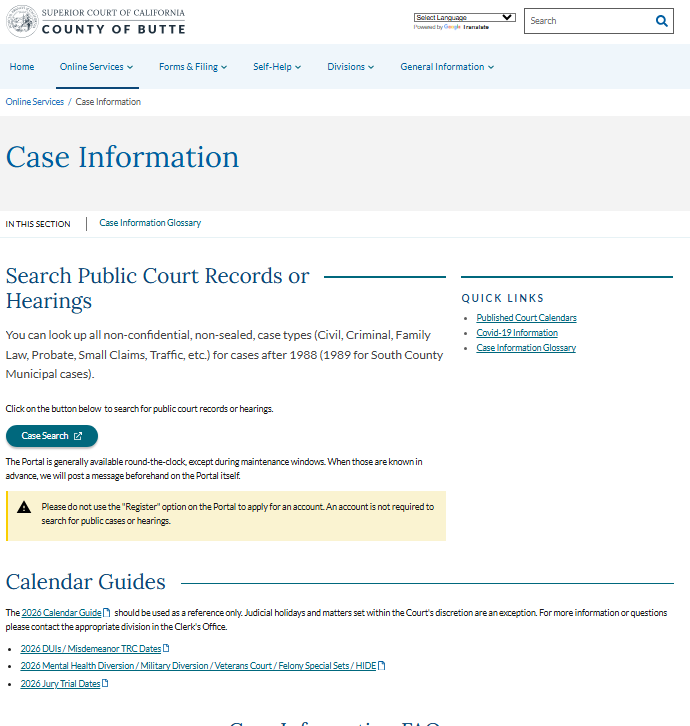
A name search helps locate probate records when a case number is unavailable. Court databases often allow searches using the deceased person’s name, the executor’s name, or other parties connected to the estate https://www.butte.courts.ca.gov/online-services/case-information. Many probate record searches begin with the decedent’s legal name. Accurate spelling often improves search results and helps narrow matching court records.
Decedent Name Search
The most common probate search method uses the deceased person’s full legal name. This search may reveal:
- Probate case numbers
- Filing dates
- Hearing schedules
- Estate administration records
- Court docket activity
Researchers frequently use this method for genealogy projects, inheritance verification, and estate record reviews.
Executor Name Search
An executor search may help locate probate cases managed by a specific estate representative. Probate filings often identify the executor appointed by the court to administer the estate.
Executor records may contain:
- Appointment documents
- Probate petitions
- Estate reports
- Court-approved filings
Beneficiary Search Possibilities
Some probate records identify beneficiaries named in wills or court-approved estate distributions. Public availability varies depending on the document type and court restrictions.
Beneficiary information may appear in:
- Probate petitions
- Estate inventories
- Distribution orders
- Filed wills
Search Probate Records by Case Number
A probate case number search often provides the fastest method for locating a specific court file. Each probate proceeding receives a unique case number that follows the matter throughout the court process. Court staff, online databases, and probate indexes frequently organize records by case number.
Probate Case Lookup Process
A typical case search includes:
- Locate the probate case number.
- Enter the number into the court search system.
- Review matching probate records.
- Examine docket activity and filed documents.
- Request copies if needed.
This method helps reduce confusion when multiple cases involve similar names.
Benefits of Case Number Searches
Case number searches offer several advantages:
- Faster record retrieval
- More accurate search results
- Easier document tracking
- Direct connection to court filings
- Better review of probate docket activity
Many attorneys and title researchers prefer case number searches for estate investigations and legal record reviews.
Probate Docket and Case Activity Records
Probate docket records track the progress of an estate case from opening filing through final court action. These records provide a timeline of activity occurring within the probate proceeding. A docket serves as the court’s official case activity log.
Common Docket Entries
Probate docket records often contain:
- Petition filings
- Executor appointments
- Hearing notices
- Objections
- Estate accountings
- Final distribution requests
Each filing receives a date and becomes part of the permanent court record.
Hearing Updates
Probate dockets often display hearing schedules and courtroom events. Users may review:
- Upcoming hearing dates
- Continued hearings
- Judge assignments
- Hearing outcomes
These updates help interested parties follow estate proceedings.
Filed Motions and Court Orders
Probate cases may include motions requesting court approval for estate actions. Examples include:
- Property sales
- Executor authority requests
- Estate settlement approvals
- Trustee-related petitions
Court orders document the judge’s decisions and become part of the official probate file.
Archived Probate Records
Archived probate records contain older court files preserved after probate cases close. Historical probate records often provide valuable information for legal research, property history reviews, and family history projects.
Older Probate Files
Archived estate files may include:
- Historical wills
- Estate inventories
- Probate petitions
- Distribution records
- Court judgments
These records can help trace property ownership and family relationships across generations.
Historical Estate Records
Researchers often review historical probate files to locate:
- Family connections
- Inheritance records
- Land transfers
- Estate settlements
- Executor appointments
Probate archives frequently contain documents unavailable through modern databases.
Probate Record Retention
California courts maintain probate records according to judicial record retention policies. Older records may be stored:
- On-site at the courthouse
- In the county archives
- In digital record systems
- In off-site storage facilities
Processing times may be longer for archived record requests.
Certified Probate Documents
Certified probate documents are official court copies bearing a certification from the court clerk. Financial institutions, title companies, and government agencies often require certified probate records for legal transactions. These documents verify that the copy matches the original court record.
Common Certified Probate Records
Frequently requested certified probate documents include:
- Certified wills
- Letters Testamentary
- Letters of Administration
- Estate distribution orders
- Probate court judgments
Certified copies often carry an official seal or certification statement.
Letters Testamentary
Letters Testamentary authorize an executor to act on behalf of an estate. Banks, investment companies, and property offices often request this document before recognizing executor authority.
The document confirms court approval of the executor appointment.
Court-Certified Wills and Estate Orders
Certified wills provide proof of the will filed during probate proceedings. Estate orders document judicial approval of actions such as property transfers and final distributions.
These documents often support:
- Property transactions
- Estate settlements
- Financial account transfers
- Legal filings
Information Found in Probate Records
Butte County probate records often contain detailed information about estates, heirs, court actions, and asset distribution. The contents vary by case, though many probate files include several core records created during estate administration. These documents help establish a complete record of the probate proceeding.
Wills and Testament Documents
Probate files often contain:
- Last wills and testaments
- Codicils
- Will validation records
- Beneficiary designations
These records explain how property was intended to pass after death.
Estate Inventories and Appraisals
Estate inventories identify property owned by the deceased person. Inventory records may include:
- Real estate
- Bank accounts
- Vehicles
- Business interests
- Personal property
Appraisals help establish estate value for court review.
Beneficiaries and Heirs
Probate records frequently identify:
- Beneficiaries named in a will
- Legal heirs
- Family relationships
- Distribution recipients
This information helps clarify inheritance rights during estate administration.
Executors and Court Representatives
Court files often contain records connected to executors, administrators, conservators, or guardians appointed by the probate court.
These records may include:
- Appointment orders
- Fiduciary duties
- Financial reports
- Estate management filings
Court Orders and Judicial Decisions
Probate court orders document key rulings made during the case. These records often include:
- Estate approvals
- Property sale authorizations
- Distribution orders
- Executor appointments
- Case closure orders
Court orders provide the official record of decisions made throughout the probate proceeding.
Where to Access Probate Court Records
Butte County probate court records are available through the local courthouse, clerk’s office, and selected online court resources. Many visitors search probate files in person through the probate division, though digital record systems may provide limited case details.
Probate Court Records Butte County: Main Courthouse Location
The primary source for probate court records in Butte County is the Butte County Superior Court probate division. Probate cases often include estate files, wills, guardianship matters, conservatorship records, and court orders connected to deceased persons or protected adults. Most courthouse records are stored at the county court facility in Oroville, California. Visitors can request file searches through the clerk’s office during public business hours. Court staff may help locate case numbers, filing dates, and probate calendar details.
Record search methods include:
- Name-based searches
- Case number searches
- Estate filing reviews
- Probate hearing schedules
- Archived courthouse records
Public terminals inside the courthouse may allow visitors to search case indexes directly. Some probate files remain restricted under California court rules, especially records containing sensitive financial or family information.
| Resource Type | What It Provides |
|---|---|
| Clerk office | Probate case files and filing help |
| Public terminals | Case lookup and hearing dates |
| Probate division | Estate and guardianship records |
| Archived files | Older courthouse records |
Online Probate Record Resources and Clerk Office Services
The Butte County Superior Court website offers online court information for many probate matters. Users may review calendars, case indexes, court forms, and department details before visiting the courthouse. The probate division handles several record-related requests through the clerk’s office. In some cases, certified copies require payment of court fees. Mail requests may be available for older probate files or document copies.
People searching probate records often prepare the following details before visiting:
- Full legal name
- Approximate filing year
- Case number, if known
- Type of probate matter
Court staff cannot provide legal advice, though they may explain filing steps and public record procedures. Many researchers use both online resources and courthouse visits to locate complete probate court records in Butte County.
How to Request Certified Probate Copies
Certified probate copies in Butte County are available through the probate court clerk’s office. A person can request official records in person or by mail after providing case details and paying the required copy fees. Certified copies often include court seals and clerk certification. These documents are commonly used for estate transfers, property matters, financial accounts, and legal filings. Clear case information helps the court process a document request faster.
Steps for Requesting Certified Probate Copies
A requester should gather key case details before contacting the probate division. Basic information usually includes the case number, full case name, filing year, and the type of probate document needed.
Probate records include:
- Wills
- Letters Testamentary
- Estate inventories
- Final distribution orders
- Guardianship records
- Probate hearing documents
The probate archive keeps many older files. Some records may already exist in digital form, though archived paper files can take extra processing time.
A standard copy request process often follows these steps:
- Locate the probate case number
- Submit a court copies request form or a written request
- Select regular or certified copies
- Pay the required fees
- Wait for court processing and delivery
Many requesters contact the clerk’s office first to confirm record availability. This step can reduce delays and prevent incomplete requests.
Fees and Mail Requests for Official Records
Certified probate copies usually cost more than standard photocopies since the court adds an official certification seal. Fees can vary depending on the number of pages and document type.
| Request Type | Typical Purpose |
|---|---|
| Standard Court Copies | Personal review or research |
| Certified Probate Copies | Legal or financial use |
| Archived File Retrieval | Older probate records |
Butte County Probate Court FAQs
Butte County probate records contain court files connected to wills, estates, guardianship matters, and inheritance cases. Many probate court records Butte County maintains are open to the public, which helps families, heirs, and researchers review estate filings, court orders, and probate process details.
Are probate records public in Butte County?
Most probate court records in Butte County are public records that people can review through courthouse systems or public search tools. These files often include wills, petitions, inventories, executor appointments, and court rulings connected to estate administration. Some files may have restricted viewing rights if they contain sensitive financial information or guardianship details involving minors. Public probate files often help families confirm inheritance records or property transfer details. Researchers and heirs frequently search these records for family history and estate information.
Can probate records be searched online?
Many probate records can be searched online through county court databases that provide case details and filing updates. Online search systems often display case numbers, filing dates, hearing schedules, and party names connected to the estate. This process helps heirs and legal researchers locate probate files without visiting the courthouse. Older probate files may still exist only in paper form and may require an in-person request from the clerk’s office. People often search Butte County probate records online to locate wills, guardianship cases, and inheritance filings.
What documents are included in probate court files?
Probate court files often contain many records linked to estate administration and inheritance matters after a person’s death. Common documents include wills, executor appointments, estate inventories, creditor notices, court petitions, and final distribution orders. Some files may contain property details, financial statements, or records showing how assets were divided among heirs. Guardianship cases may include court evaluations, care plans, and legal appointment records. These probate court records help show the full history of an estate case from filing to closure.
How do people request copies of probate records?
People can request copies of probate court records through the probate clerk’s office by providing case details or party names. Requests may happen in person, by mail, or through online systems if the court provides digital services. Certified copies often cost more than regular copies since they include an official court seal for legal use. Many families request probate documents for property transfers, insurance claims, or inheritance disputes. Accurate case information often helps speed up the request process and reduces record search delays.