Butte County juvenile court records refer to official court documents created in matters involving minors handled within the Butte County court system. These records typically relate to sensitive proceedings such as delinquency actions, dependency cases, probation supervision, guardianship matters, and other juvenile-related hearings. The keyword Butte County juvenile court records often refers to these sealed or restricted files maintained under California juvenile law. In most situations, these records are not part of the general public court data due to privacy protections established for minors involved in legal proceedings.
Juvenile records in Butte County are treated with strict confidentiality under California state regulations to protect the identity and future of minors involved in juvenile cases that Butte County courts handle. Only authorized parties such as parents, legal guardians, attorneys, or court-approved agencies may view specific case information. These restrictions limit exposure of sensitive details like case reports, court rulings, and probation notes. This section serves as an informational overview of how juvenile court records are categorized, why confidentiality exists, and what types of juvenile matters are typically recorded within the local court system.
What Are Juvenile Court Records in Butte County?
Butte County juvenile court records are official files that document legal matters involving minors within the juvenile justice system. These records cover cases handled in juvenile court, including delinquency, dependency, and supervision matters. These records for juvenile cases in Butte County are generally kept separate from adult court files and follow stricter confidentiality rules to protect minors involved.
Definition of Juvenile Court Records in Butte County
Butte County juvenile court records refer to legal documents created during court proceedings involving individuals under 18 years old. These records form part of the local juvenile justice system and track how each minor’s case moves through court review, supervision, or rehabilitation.
These records may include:
- Court petitions filed against a minor
- Hearing notes and rulings
- Supervision plans from probation officers
- Case evaluations related to behavior or home environment
- Final court decisions and follow-up orders
The term minor records is often used to describe these files since they relate only to individuals under legal adult age. Courts treat them with higher privacy controls compared to adult criminal files. Many entries remain sealed or partially restricted depending on case type and outcome.
Types of Juvenile Cases in Butte County
Juvenile cases Butte County courts handle different categories that focus on behavior, family conditions, and legal responsibility. These cases fall under the delinquency proceedings or dependency framework, depending on the situation.
Case types include:
- Delinquency cases: Actions that would be crimes if committed by an adult, such as theft or vandalism
- Status offenses: Actions like truancy or curfew violations that apply only to minors
- Dependency matters: Cases involving neglect, abuse, or unsafe home environments
- Probation matters: Court-supervised behavior monitoring after a ruling
Case Categories at a Glance
| Case Type | Description | Case Focus |
|---|---|---|
| Delinquency | Rule violations or offenses | Behavior and accountability |
| Dependency | Unsafe living conditions | Child welfare |
| Probation | Court supervision | Compliance and progress |
Each category falls under juvenile court records in Butte County and reflects how the court responds to different situations involving minors.
Arrest-Related, Dependency, and Probation Records
Arrest-related juvenile cases form one part of Butte County juvenile court records. These records involve situations where law enforcement detains a minor for alleged unlawful conduct. The court reviews evidence, then decides on rehabilitation steps or diversion programs.
- Dependency cases:
- Dependency cases focus on family safety. These files may include reports from social services, school records, and court evaluations that describe home conditions. The goal is to address neglect or abuse concerns.
- Probation records:
- Probation records track a minor’s behavior after court decisions. A probation officer monitors compliance with rules such as school attendance, counseling, or community service. These records may show progress reports, violations, or completed requirements.
Together, these record types form a structured record set within the juvenile justice system. They help the court track behavior patterns, family conditions, and long-term outcomes for minors involved in legal proceedings.
How Juvenile Records in Butte County Are Requested
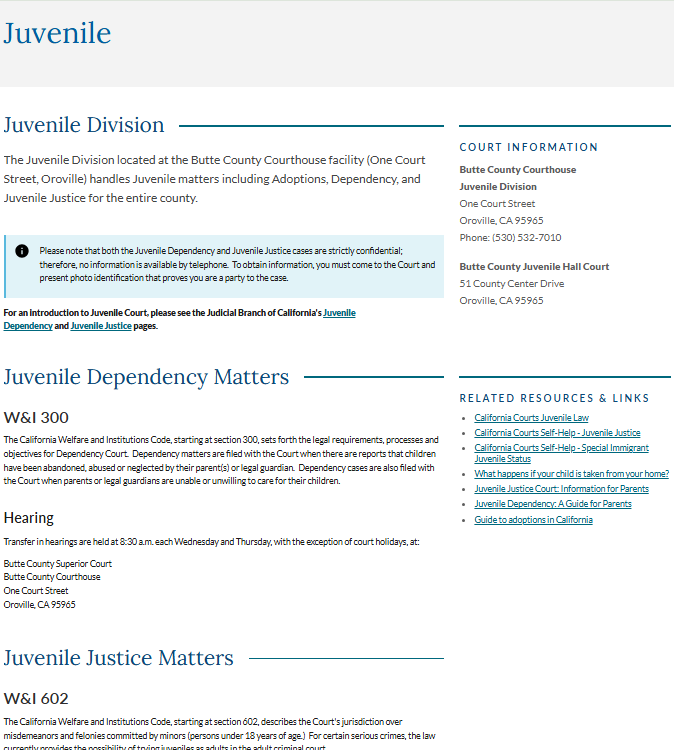
Butte County juvenile court records are not released for general viewing and remain protected under strict confidentiality laws. Only approved persons with valid legal standing can submit a formal record request https://www.butte.courts.ca.gov/divisions/juvenile, through the court clerk’s office. These records involve youth offender cases, custody matters, and delinquency proceedings, so every request is reviewed with care before any file is released.
Who May Submit a Juvenile Case Record Request
Butte County juvenile court records are limited to specific parties who can show a legal connection to the case. The court does not allow public viewing due to privacy rules.
Eligible requesters often include:
- Parents or legal guardians linked to the juvenile case
- The minor involved, based on court eligibility rules
- Attorneys representing any party in the case
- Law enforcement agencies tied to an investigation
- Court-approved agencies involved in supervision or welfare
- Persons with written court permission
Requests without legal standing are typically denied by the court clerk’s office.
Steps Followed at the Court Clerk’s Office
The record request process at the court clerk’s office follows a structured review system. Each submission is checked for eligibility before any document handling begins.
Steps involved:
- Written submission of the request form
The form must include case number, names, and filing details. - Statement of legal purpose
The requester explains why juvenile case records are needed under permitted conditions. - Clerk’s office review
Staff reviews the request under California juvenile confidentiality laws. - Decision outcome
Approval or denial is issued after evaluation. - Record viewing or copy release
Approved parties may view files in a controlled courthouse setting or receive certified copies if allowed.
Some files may remain partially sealed depending on case sensitivity.
Required Documents for Juvenile Case File Requests
Supporting documents play a major role in the record request process. The court clerk’s office requires proof of identity and legal connection before reviewing any file request.
Documents include:
- Valid government-issued photo ID
- Case number or identifying case details
- Proof of relationship (parental or guardianship documents)
- Attorney authorization letter, if applicable
- Court order permitting review of juvenile records
Legal standing conditions:
| Requirement Type | Purpose |
|---|---|
| Identity proof | Confirms requester identity |
| Case link | Shows connection to juvenile matter |
| Legal authority | Establishes right to review case files |
| Court permission | Written approval is required when necessary |
Without these documents, Butte County juvenile court records are not released for viewing or copying.
Types of Juvenile Cases in Butte County
Juvenile cases in Butte County fall into distinct categories based on the behavior, age, and situation involved. These matters are handled within the juvenile court system and recorded as part of juvenile cases in Butte County records. Each case type reflects a different legal concern involving minors. The classification shapes how juvenile hearings and delinquency proceedings move forward in court.
Status Offenses and Dependency Cases in Butte County
Status offenses refer to actions considered violations only because of the minor’s age. These cases do not involve criminal acts that would apply to adults. Common examples include truancy, running away from home, and curfew violations. Dependency cases focus on a child’s safety and home environment. These matters arise when concerns exist about neglect, abuse, or lack of proper care. The court reviews the child’s living conditions and decides on suitable supervision or placement.
Features of these case types include:
- Status offenses tied to age-based rules
- School attendance issues linked to truancy
- Home safety concerns in dependency filings
- Court involvement focused on supervision and support
- Placement decisions involving guardianship or foster care
These cases often involve social services and structured monitoring during juvenile hearings.
Delinquency Proceedings and Youth Offender Cases
Delinquency proceedings involve acts that would be crimes if committed by adults. These include theft, vandalism, assault, and drug-related activity. In Butte County, these matters form a large share of juvenile cases in the Butte County court records. Youth offender cases focus on accountability and behavior correction. The court reviews evidence, hears statements during juvenile hearings, and decides outcomes based on the severity of the act and prior history.
Delinquency proceedings may involve:
- Property-related offenses such as burglary or theft
- Violent acts, including assault or threats
- Substance-related violations involving controlled items
- Repeat offenses leading to stricter supervision
Court responses vary from counseling requirements to structured detention programs. The process aims to balance accountability with rehabilitation-focused outcomes.
Probation Supervision and Case Classification in Butte County
Probation supervision plays a central role in juvenile court outcomes. Many minors placed under probation must follow specific conditions set by the court. These conditions may include school attendance, counseling sessions, or community service. Case classification in juvenile cases, Butte County records, helps determine the level of supervision. Each category receives different monitoring rules and reporting requirements.
| Case Type | Core Focus Area | Typical Court Response |
|---|---|---|
| Status Offenses | Age-related conduct | Counseling, supervision orders |
| Dependency Cases | Child safety | Placement or protective care |
| Delinquency Proceedings | Criminal-type acts | Rehabilitation programs, detention |
| Probation Cases | Behavior monitoring | Regular reporting and restrictions |
Probation officers track compliance and report progress during scheduled juvenile hearings. This structured system supports accountability while keeping focus on behavioral correction.
Are Juvenile Records Public in California?
Juvenile records in California are not public in most situations, including Butte County Juvenile Court Records. State law keeps these records private to protect minors involved in juvenile cases. Only specific parties receive permission to view them under strict conditions.
Confidentiality rules for juvenile records in California
California law treats juvenile matters with strong privacy protection under juvenile justice privacy standards. Records created in delinquency or dependency cases stay confidential to prevent long-term harm to minors. These files often include court hearings, probation reports, and case outcomes. Under confidentiality rules, juvenile records are separated from adult criminal records. They do not appear in standard public searches or general court listings. This separation supports rehabilitation instead of public labeling.
Points of confidentiality include:
- Juvenile court files remain sealed from public review in most cases
- Case details are stored under restricted court systems
- Public reports exclude the names of minors involved
- Records may be labeled as sealed records after eligibility conditions are met
California Welfare & Institutions Code § 827 supports this structure by limiting who may review juvenile case files.
Who can review Butte County Juvenile Court Records?
Only specific people or organizations may review Butte County Juvenile Court Records under court permission rules. The system focuses on limiting exposure while still supporting legal and protective needs.
Those who may review juvenile case files include:
- Parents or legal guardians of the minor
- The minor involved in the case, under certain conditions
- Attorneys representing the minor or family
- Probation officers assigned to the case
- Court-authorized social workers or evaluators
Record review eligibility table:
| Party Type | Permission Level | Reason for Review |
|---|---|---|
| Parent/Guardian | Full within case scope | Legal responsibility for minor |
| Defense Attorney | Full case file review | Legal representation |
| Probation Officer | Case-related files | Supervision duties |
| Law Enforcement | Limited review | Active investigation support |
| General Public | No permission | Privacy protection |
This structure keeps juvenile matters private while still allowing legal representation and supervision functions to operate effectively.
Court restrictions and sealed records exceptions
Court restrictions play a major role in protecting juvenile files from broad exposure. Judges in Butte County apply strict rules on who may review documents tied to juvenile hearings or probation outcomes. Even after a case closes, many records remain sealed. A sealed record means the file exists but cannot be shown without court approval. This step supports rehabilitation by limiting long-term impact on a minor’s future.
Exceptions where limited review may be granted include:
- Law enforcement during active investigations
- Prosecutors are preparing related juvenile or adult cases
- Attorneys involved in appeals or connected hearings
- Court orders issued for specific legal reasons
In rare situations, a judge may authorize review if safety or legal fairness requires it. Even then, only selected portions of the file may be shown.
How Juvenile Hearings Work in Butte County
Juvenile hearings in Butte County follow a structured court process that reviews allegations involving minors and decides case outcomes. These hearings focus on rehabilitation, supervision, and legal responsibility in juvenile cases in Butte County. Cases move through scheduled court proceedings where a judge reviews reports, testimony, and recommendations before making decisions.
Juvenile Hearing Process in Butte County Courts
Juvenile hearings begin after law enforcement or probation officials file a report with the court. The minor receives notice of the hearing date and is often represented by a defense attorney. A parent or legal guardian is usually required to attend. During juvenile hearings, the court reviews facts related to the incident. The judge considers police reports, school records, and statements from involved parties. In many cases, a probation officer prepares a social study report that helps the court evaluate background details.
A typical hearing sequence includes:
- Initial Detention Hearing: Reviews whether the minor stays in custody or returns home
- Adjudication Hearing: Works like a fact-finding stage, similar to trial proceedings
- Disposition Hearing: Determines outcomes such as counseling, probation, or placement programs
Hearings follow a structured timeline, but scheduling may vary based on case load and severity of the allegation. Judges focus on accountability and behavioral correction rather than punishment alone.
Roles of Court Staff and Rehabilitation Programs in Juvenile Cases, Butte County
Several court roles shape the direction of juvenile hearings. Each role supports decision-making and case review in juvenile cases in Butte County.
Participants include:
- Judge: Makes final rulings after reviewing all reports
- Defense attorney: Represents the minor’s legal interests
- Probation officer role: Prepares background reports, monitors behavior, and recommends supervision plans
- Prosecutor: Presents case facts on behalf of the state
Probation officers play a central part by assessing school performance, home environment, and prior incidents. Their reports often influence court decisions on supervision levels.
Sealed vs Expunged Juvenile Records
Sealed juvenile records in Butte County restrict who can view the file, but the record still exists within the court system. Expunged juvenile records in California involve formal removal actions that close or erase certain legal effects tied to the case. Both processes relate to minor records and fall under rules for juvenile court records in California, yet they serve different legal purposes and outcomes.
Sealed Records in Butte County Juvenile Cases
Sealing juvenile records limits public visibility while keeping the file stored in court systems. In Butte County, sealed files are removed from general background checks used by employers or housing providers. The record still exists for limited legal uses such as court review or law enforcement review, under restricted conditions.
Sealed record effects include:
- Case details hidden from public searches
- Restricted visibility for most background checks
- Court file retained in secured storage
- Limited use for future juvenile proceedings
Sealing often applies to non-serious offenses or cases where rehabilitation has been shown through time without new incidents. It is a common step for individuals seeking reduced long-term impact from past juvenile involvement.
Expungement of Juvenile Records in California
Expungement refers to a formal court process that removes legal consequences tied to a juvenile case. In California, expungement does not always erase the record, but it modifies the case status to show dismissal after completion. For juvenile court records in California, expungement usually applies when court-ordered terms have been completed.
Typical effects of expungement include:
- Case marked as dismissed after completion
- Relief from many legal penalties linked to the case
- Reduced visibility during background screening
- Improved eligibility for certain opportunities
Expungement often applies when probation terms, fines, or counseling requirements are completed without further legal issues.
(FAQs) About Butte County Juvenile Court Records
Butte County juvenile court records involve sensitive case files from youth proceedings handled by the county court system.
Are juvenile records public in Butte County?
Butte County juvenile court records are generally not open for public viewing under strict court confidentiality rules. Most juvenile cases, Butte County filings stay protected to safeguard minor identities and case details. Only limited information may be released with court permission in specific legal situations. Juvenile hearings often remain closed to outside parties. These court access rules support privacy for minors involved in the system.
Can juvenile records be removed or sealed?
Many Butte County juvenile court records may qualify for sealing after meeting court requirements. Sealed records do not appear in routine record searches and remain confidential under court policy. Eligibility depends on case type, completion of required terms, and case outcome. A formal petition is needed for review by a judge. Courts review rehabilitation history before deciding on sealing.
Who can view juvenile court records?
Viewing rights for juvenile cases in Butte County remain limited under state confidentiality laws. Parents, legal guardians, attorneys, and authorized court staff may review approved files. Law enforcement may review selected records with court permission. Public viewing is not permitted for most juvenile files due to privacy rules. Court approval controls any release of restricted juvenile information.
How long are juvenile records kept?
Retention of Butte County juvenile court records depends on case type and court record policies. Some records remain stored into adulthood, mainly for serious juvenile cases. Other records may be sealed after meeting legal conditions and time requirements. Courts retain files in secure systems for legal history and recordkeeping. These rules maintain confidentiality and long-term privacy for juvenile matters.
What information is included in juvenile court records?
Butte County juvenile court records usually include case details, hearing notes, and final court decisions. They may also contain arrest reports, probation terms, and rehabilitation plans tied to juvenile cases in Butte County. These records are kept under strict confidentiality rules to protect minors involved in proceedings. Some files may show court orders and judge rulings, depending on the case type. Public release remains limited under court access rules and privacy protections.